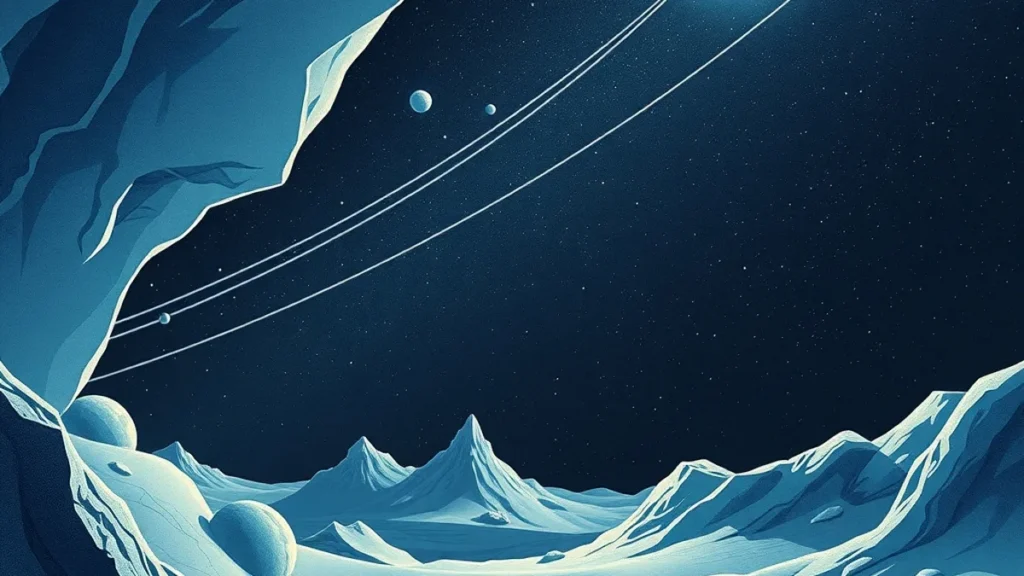
Astronomers analyzing orbital anomalies past Neptune have uncovered compelling computational evidence of a massive, previously undetected planet lurking on the outer fringes of the Solar System. Announced this week, the hypothetical world—roughly twice the size of Earth and tentatively dubbed “X2″—could fundamentally rewrite current models of planetary formation and deep-space dynamics.
Gravitational Anomalies Beyond Neptune’s Frozen Frontier
For decades, the outer boundary of the Solar System was presumed to fade quietly into a sparse cloud of icy debris known as the Kuiper Belt, stretching past the orbit of Neptune at roughly 30 Astronomical Units (AU)—where one AU represents the distance between Earth and the Sun. However, recent observational syntheses and trajectory mapping published by BBC Sky at Night Magazine and ScienceAlert reveal that dozens of remote icy bodies in this realm display strange, highly elongated orbits that cluster in ways that cannot be explained by the known gravitational pull of the recognized eight planets.
Rather than dispersing randomly through interstellar space, these Trans-Neptunian Objects (TNOs) appear bound by the persistent tug of a hidden, massive body. As reported by New Atlas, early calculations suggest the unseen object possesses a physical volume approximately twice the size of Earth, making it significantly larger than Pluto or any known dwarf planet in the Kuiper Belt. This unexpected magnitude places the object squarely in the category of a “Super-Earth” or a mini-Neptune—a planetary class abundant across distant star systems in the Milky Way, yet curiously absent from our immediate solar neighborhood.
The statistical probability of these distant orbits aligning purely by chance is less than 0.2 percent, according to astrophysical models cited in the reports. This mathematical improbability has shifted the theoretical search from speculative hypothesis to structured observational campaign, as teams across multiple continents align ground-based and orbital observatories to scan the dark patches of sky where the object’s gravitational shadow is most heavily concentrated.
Mathematical Modelling and the Search for Planet X2
The identification of candidate world X2 relies heavily on sophisticated orbital perturbation algorithms. According to reporting from the Australian Broadcasting Corporation (ABC News), advanced numerical simulations designed to track the long-term dynamical evolution of the outer Solar System indicate that only a body of substantial mass—ranging between two and five Earth masses—could maintain the observed orbital inclination and perihelion alignment of distant TNOs over billions of years.
This method of discovery mirrors the historical detection of Neptune in 1846, when French mathematician Urbain Le Verrier calculated the location of an unseen world by analyzing unexplained irregularities in Uranus’s orbit. Today, supercomputing clusters simulate millions of gravitational permutations across cosmic timescales to narrow down the precise orbital corridor of Planet X2. As researchers crunch massive astronomical datasets using high-performance computing systems—a reflection of the broader technological boom where consumers monitor retail events like Top Black Friday laptop deals for 2026: Save up to $1,500—astrophysicists are utilizing identical silicon processing power to model the faint gravitational footprint of this distant candidate world.
The proposed orbit of X2 is believed to be exceptionally elongated, carrying the world anywhere from 200 AU to more than 600 AU from the Sun. At such distances, a complete revolution around the star would take between 10,000 and 20,000 Earth years. This immense distance explains why the planet has eluded detection by conventional sky surveys for over a century, despite its substantial physical dimensions.
Direct Detection Bottlenecks in the Solar System’s Dark Depths
Observing a planet at the extreme edge of our Solar System presents formidable engineering and optical hurdles. As detailed by The Times, sunlight reaching the region beyond Neptune is tens of thousands of times fainter than the light reaching Earth. Because a planet’s visible brightness depends on reflecting sunlight back across hundreds of astronomical units, its apparent illumination drops inversely with the fourth power of its distance from the Sun.
Consequently, X2 would be exceedingly dim, reflecting almost zero visible sunlight toward Earth. Astronomers must instead rely on detecting the planet’s faint intrinsic thermal radiation—residual heat left over from its formation nearly 4.5 billion years ago. At temperatures hovering near absolute zero, this radiation emits almost exclusively in the far-infrared and submillimeter spectrum, wavelengths that are largely absorbed by Earth’s atmosphere and require specialized space-based observatories or high-altitude arrays to detect.
The upcoming generation of astronomical hardware, including wide-field survey facilities like the Vera C. Rubin Observatory in Chile, is specifically engineered to search for extremely faint, slow-moving targets across large swaths of the sky. By taking repeated, high-resolution snapshots of the southern sky over a ten-year period, astronomers hope to catch the tiny optical displacement of X2 against the backdrop of fixed stars, confirming its existence through direct optical verification.
Comparative Planetology and the Meaning of an ‘Earth-Like’ Frontier
The designation of X2 as an “Earth-like” world by some observational outlets refers primarily to its planetary structure and potential terrestrial dynamics, rather than the presence of liquid water or habitability. In planetary science, an Earth-like world of twice our planet’s diameter would likely possess a rocky core surrounded by a dense mantle and a thick atmosphere of volatile gases, nitrogen, and water vapor frozen into high-pressure ice phases.
If confirmed, the discovery would resolve one of the most puzzling questions in modern planetary science: why the Solar System appeared to lack a planet with a mass intermediate between Earth and Neptune. Exoplanet surveys conducted by NASA’s Kepler and TESS space telescopes have revealed that Super-Earths are the most common type of planet in the galaxy. Finding one within our own outer system would prove that planetary formation mechanisms in our solar nebula were far more diverse and chaotic than previously understood.
This profound cultural shift in how humanity visualizes its cosmic home reflects a broader fascination with uncharted boundaries. Similar to how artistic narratives push beyond familiar boundaries—much like how Blade Runner 2099 explores themes beyond AI, say Hunter Schafer—the scientific pursuit of X2 forces astronomers and the public alike to re-examine the limits of our environmental awareness and the sheer scale of the unexplored territories residing right on our cosmic doorstep.
Supply Chains, Scientific Infrastructure, and Global Research Pressures
Building the advanced hardware required to discover and analyze objects like Planet X2 demands massive international funding and intricate global supply networks. Modern astronomical observatories rely on high-precision optical glass, ultra-sensitive charge-coupled detectors, and specialized cryogenic cooling units manufactured across multiple continents. Consequently, macro-economic conditions directly impact the pace of deep-space discovery.
Inflationary pressures and shifts in global trade policy present logistical challenges for major research consortia. As the White House announces new tariffs on China and Vietnam amid inflation surge, university laboratories and international observatory initiatives face rising costs for advanced electronics, sensor chips, and structural components. These economic realignments have forced observational teams to optimize existing data streams and rely heavily on open-source astronomical archives rather than waiting for new, costly space missions to launch.
Despite these economic headwinds, international cooperation in astronomy remains remarkably resilient. Data sharing protocols between European, American, and East Asian observatories ensure that when anomalous motion is detected in deep-sky surveys, multiple telescopes across different longitudes can immediately pivot to confirm the object’s coordinates, accelerating the timeline toward potential validation of X2.
Rewriting Solar System Evolution and the Path to Confirmation
The existence of a planet twice the size of Earth far beyond Neptune would necessitate a complete rewrite of early Solar System evolution models. Under current nebular theory, the protoplanetary disk at distances of several hundred AU would have been far too diffuse to allow a planet of two Earth masses to accrete in situ. Therefore, X2 could not have formed where it currently resides.
Instead, theoretical astrophysicists hypothesize that X2 formed much closer to the Sun during the violent early epochs of the Solar System, somewhere in the giant planet region alongside Jupiter, Saturn, Uranus, and Neptune. As the gas giants migrated, complex gravitational interactions could have gravitationally slingshotted X2 outward into an extreme, eccentric orbit, where it remained trapped in the cosmic freezer of the outer realm for billions of years.
Over the coming months, observational teams will continue analyzing sky survey data to lock down candidate positions for X2. While mathematical models provide strong circumstantial evidence, definitive confirmation requires direct optical or infrared detection across multiple observation windows. Until then, Planet X2 remains the most compelling scientific ghost in modern astronomy—a massive, silent sentinel potentially guarding the dark edge of our Solar System.
Note: This article is intended for informational and educational purposes only and does not constitute technical advice, academic certification, or official endorsement by space agencies. Scientific hypotheses regarding unconfirmed planetary candidates are subject to ongoing peer review and observational verification.
Sources and Reporting
- BBC Sky at Night Magazine: Astronomers may have found a second Earth-like planet on the edge of our Solar System
- New Atlas: Planet twice the size of Earth detected in the Solar System’s darkness
- The Times: Dark depths of solar system may hide a ninth planet dubbed ‘X2’
- ScienceAlert: Astronomers Find Signs of a SECOND Earth-Like World in The Space Beyond Neptune
- ABC News & Headlines – Australian Broadcasting Corporation: New modelling suggests presence of hidden ninth planet
Editorial note: This article was drafted with the assistance of artificial intelligence from publicly available reporting and passed automated editorial checks. The illustration is AI-generated and does not depict a real event or real people. Spotted an error? Email [email protected] or read our Corrections Policy and Editorial Policy.